Economy & Population
Who already lives around Nusantara, who's expected to arrive, and what's actually been invested so far.

Economy & Population
Nusantara's economic story runs on two tracks at once: a set of long-term targets for 2045, and a fast-moving, already-happening wave of real construction and investment that started in 2023. This page covers both, plus the people, past, present, and future, that the numbers are actually about.
Who was here first
An estimated 150,000 people already lived in the area before it was chosen as Nusantara's site. That's a specific, sizeable number worth holding onto whenever you see Nusantara's future population targets. Indonesia's own planning documents commit, at least on paper, to handling any necessary relocation with free, prior, and informed consent, and to not sacrificing local and marginalized communities' interests to the project's momentum.
Who's expected to live here, and when
Three different numbers, three different things. 150,000 is who was already there before construction began. 1.7 to 1.9 million is Nusantara's full built-up area by 2045. 171,037 is just the government core (KIPP), a small fraction of Nusantara's total land. Don't mix these up, they're not competing estimates of the same thing.
The vision: an "Economic Superhub"
Nusantara's master plan positions the city as an economic driver for the whole country, not just a government seat. The stated target is a per-capita GDP of USD 13,900 to 14,700 by 2045, on par with a high-income economy, and East Kalimantan's regional GDP is targeted to roughly triple by the same year as part of Indonesia's broader 2045 economic vision.
One claim we couldn't verify. Official documents say this economic target depends on supporting "6 industry clusters and 2 enablers," but despite an exhaustive search across every government planning document available to us, including the one that made the claim, we could never find what those clusters actually are. If this framing gets used elsewhere, treat the specific number and structure as unconfirmed until a source naming the actual clusters turns up, most likely Indonesia's original 2022 master plan regulation itself.
What's actually been built and invested so far
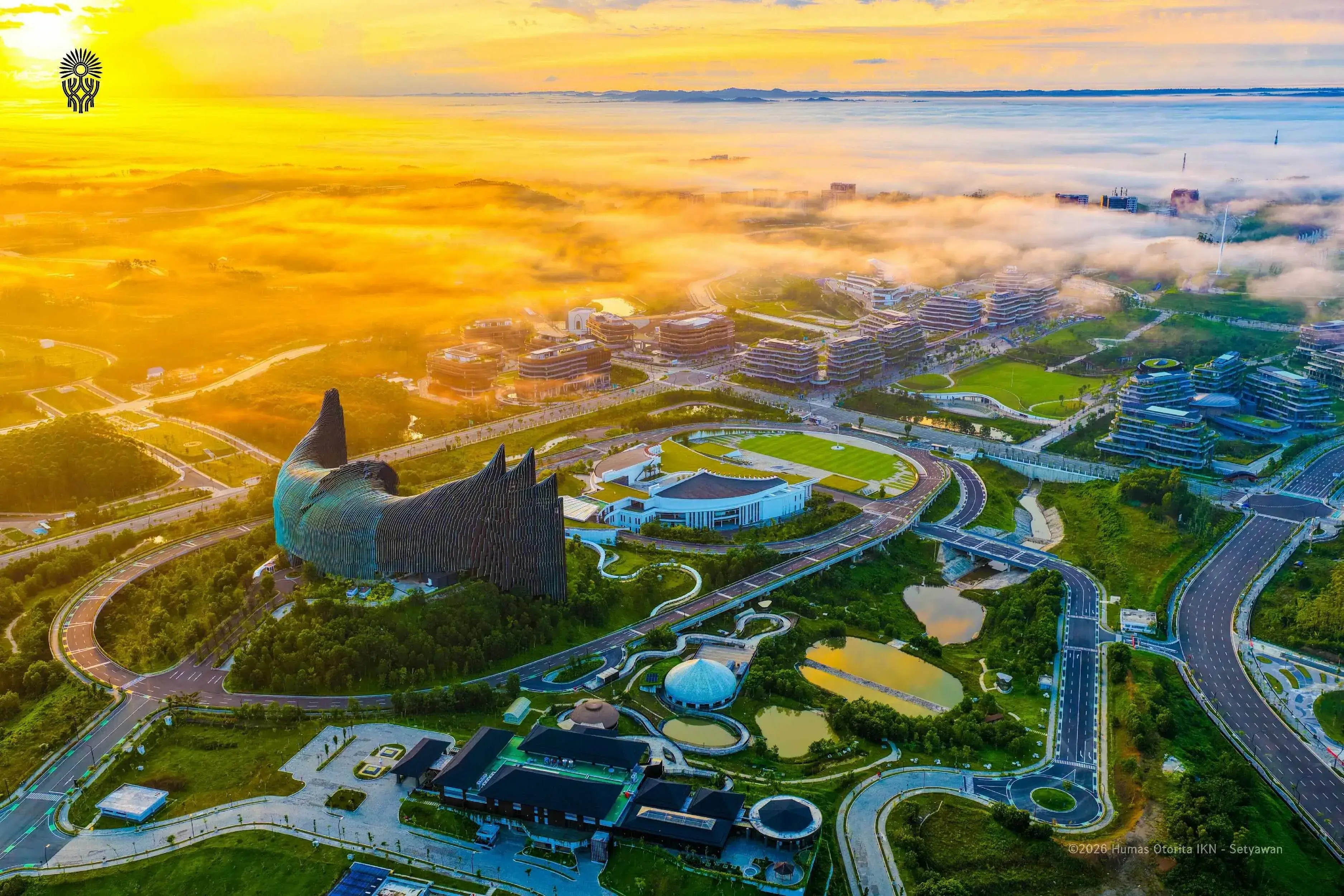
As of a January 2024 progress report, overall construction in Nusantara's first phase stood at 71.57% complete. The Presidential Palace and Ceremonial Field were 53.88% complete, the first stretch of the National Axis (Sumbu Kebangsaan) was 97.61% complete, and the Sepaku Semoi Dam supplying the city's water was fully finished.
Total investment into this first phase reached Rp47.5 trillion, of which Rp35.9 trillion came from private investors, spread across hotels, housing, retail and logistics, offices, education, health, energy and transport, and green space projects.
Interest from abroad
Three waves of groundbreaking, 2023
Private investment arrived in three concentrated bursts during 2023:
September 2023: Hotel Nusantara, backed by a 10-company consortium led by Agung Sedayu Group, at Rp20 trillion. Abdi Waluyo Hospital, the first private hospital in Nusantara, 400 beds, Rp2 trillion.
November 2023: Mayapada Hospital Nusantara and Hermina Hospital (a "green hospital" concept), alongside a Rp5 trillion mixed-use development from Pakuwon Jati facing the Zero Point monument directly, bringing in Marriott International with a Four Points by Sheraton, a Tribute Portfolio hotel, and a Westin. Combined investment this wave: Rp12.5 trillion. Also included: a Bank Indonesia office and the city's first 50 MW solar plant.
December 2023: The Pakubuwono Nusantara apartment towers (Rp1 trillion), plus green transport infrastructure from PT Bluebird, specifically Bus Rapid Transit and electric taxi services for residents.
Separately, a housing pipeline of 166 residential towers and 159 landed houses, worth an indicative Rp55 trillion, is targeted for construction in 2025, split between domestic developers (Summarecon, Ciputra, Intiland, among others) and international ones (Malaysia's Maxim and IJM, China's CITIC Construction).
Why anyone would invest
The government's target is for 80% of Nusantara's total funding to come from outside the state budget. To make that attractive, PP No. 12/2023 sets out a specific package of incentives for business actors:
Land rights: no land/building acquisition tax; the right to cultivate land for 95 years, to build for 80 years, and to manage land for 80 years.
Fiscal incentives: a tax holiday, a super-deduction, customs exemptions for 4 to 6 years, 0% corporate income tax for 10 years, and 0% on import VAT, luxury goods tax, import duty, and land and building tax for 10 years.
A risk the plan itself acknowledges
Rapid, investment-driven development like this carries a real risk: it can make inequality worse, not better, if wealthier newcomers move in around existing lower-income residents. Nusantara's own planning documents don't shy away from this. Between 2021 and 2022, East Kalimantan's Gini ratio, a standard measure of income inequality, actually rose from 0.331 to 0.359, even before major construction began, evidence the risk is real, not hypothetical.
The stated target is to reverse that trend and reach the lowest regional Gini ratio in Indonesia by 2045. The specific mitigation strategies named are: completing a full mapping of the local workforce, improving skills and education with direct competency transfer to surrounding communities, actively placing trained local workers into Nusantara's own industries, working with local government and private companies on this directly, and investing in the surrounding region's own existing strengths (tourism, local flagship products, the creative economy, and cultural arts) rather than treating the existing population as separate from Nusantara's growth.
None of this happens in isolation from Indonesia's wider energy transition either. East Kalimantan is currently the country's largest coal-producing province, and Nusantara's own strategy explicitly frames itself as part of a "just transition" away from that economy, acknowledging that phasing out coal will cost real jobs that need active support, not just be absorbed as a side effect. See Sustainability & Biodiversity for the environmental side of that same transition.
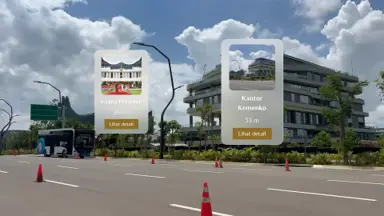
Are you in IKN? Explore Nusantara in AR
NewPoint your phone's camera and discover locations around you in real time, complete with live distance and direction.